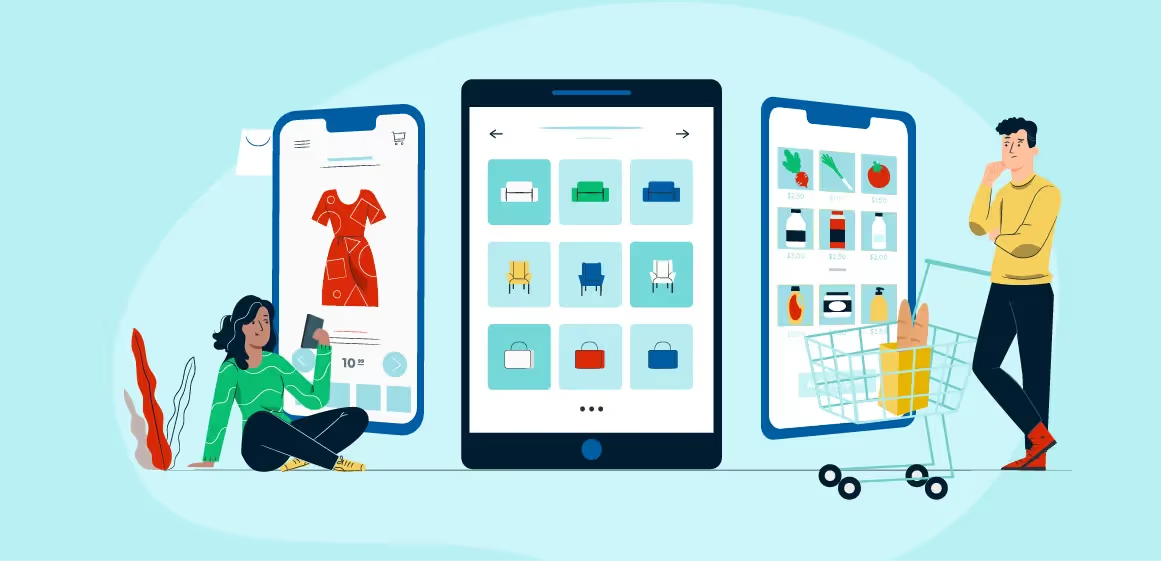
Did you know that customers, both B2B and B2C, shopped for some things which they never thought they would buy online, during the pandemic, Bloomreach found in a study. The same report mentions that “44% of B2C buyers and 58% of B2B buyers say they always or often research a product online before going to a physical store”
The digital trends that have emerged during and post the pandemic will shape the rest of the 21st century. We are standing at a juncture where the old and existing e-commerce models are crumbling and new digital strategies are taking shape which will create the winning difference in tomorrow’s age.
Today customers live in a connected multiverse with simultaneous interaction happening on multiple devices and platforms. Businesses need the ability to not only just control the digital experience that they are offering (at every single one of those touchpoints) but also the ability to predict the user behavior and then offer tailored, customised content according to their needs.
Age of the consumers
What do you think is the reason that a single mishandled customer can snowball into a full-fledged controversy and a PR nightmare? It's because of the fact that we are in the ‘Age of the consumers’ as Forrester Research calls it. Today, customers have truly become the king, with their presence on every platform and device which have changed the engagement models dramatically.
All this has been put to fast forward during and after the pandemic. With brick-and-mortar stores shut all through 2020, all across the globe, more and more businesses found themselves thriving on the digital landscape. The trends that have emerged clearly showcase that it's only a matter of time till all of the businesses will move to a 100% digital mode.
For an e-commerce business, it's even more challenging. For a B2B e-commerce, even more than that. Data from Statista shows that in the United States, there were 10 connected devices per person in 2020. Thus, the challenge for businesses (both B2B and B2C) has exploded manifold.
How traditional technology stacks are now incomplete
At the beginning of this century, content management systems were all the rage. With all the nifty features and advantages (of that time), CMSes were quite advanced for a fair amount of time. But the needs of the customer, and the businesses evolved and CMSes started feeling inadequate.
Next came Web Experience Management platforms, which were a much better addition to businesses’ technology stack. WEM platforms were an expanded version of the CMS with the neat addition of analytical tools.
But the evolutionary machine was still on and advancements were still demanded from these platforms on a holistic and nuanced level. This is what gave birth to digital experience platforms.
What do modern e-commerce businesses need?
Do you think that your business will benefit from an “integrated set of core technologies that support the composition, management, delivery and optimization of contextualized digital experiences.”
If you answered yes to the above question, then you need a Digital Experience Platform (DXP) for your business. This is how Gartner defines a DXP.
The ultimate tool in any modern e-commerce business’ arsenal, DXPs are tools that you need to talk to and listen to the customers. Agnostic of the platform, device, geographic and every other digital constraint enterprises are facing.
For an e-commerce business specially, DXPs can create the winning difference by placing the right content on the right platform at the right time for the right customer. Leveraging advanced technological innovations such as Artificial Intelligence and Machine Learning, DXPs offer personalisation at a level never thought was possible.
Various components of a DXP machine
The Gartner definition talks about an ‘integrated set of core technologies’. So what are these core technologies?
How do DXPs elevate the E-commerce digital experience
Using a DXP, you can convert leads faster, display product information in a better and an elegant fashion while engaging the customer on an entirely different level. These are the few functions that a DXP performs in order to achieve this.
Top 5 DXPs for e-commerce
Acquia Open DXP: Acquia’s Open DXP combines data and content to deliver exceptional business results on a flexible and open platform for all your e-commerce DXP needs.
Adobe experience manager: AEM delivers fast, content led experience combining the power of a content management system with digital asset management.
Salesforce experience cloud: Salesforce Experience Cloud lets you build connected websites, portals and applications in a fast, swift and agile manner resulting in faster audience engagement and interactive sites.
Sitecore experience platform: Sitecore experience platform combines customer data, AI and analytics to provide real-time customization across an omnichannel delivery.
Drupal DXP: Drupal is a great open source platform which can be used to build Digital Experience Platforms for e-commerce companies. With its API-first approach and modular architecture Drupal emerges as a great contender for an e-commerce DXP. Drupal being open source, costs much less than other DXPs in the market. There are an abundant number of modules to pick and choose from, to customize your DXP. It also integrates easily via its API-first architecture and blends it all very smoothly to offer a powerful digital experience platform for your e-commerce business.
Conclusion
We have hands-on experience building digital experience platforms that exceed expectations. We have done this for numerous e-commerce clients till now and can do the same for you. All you have to do is get in touch.